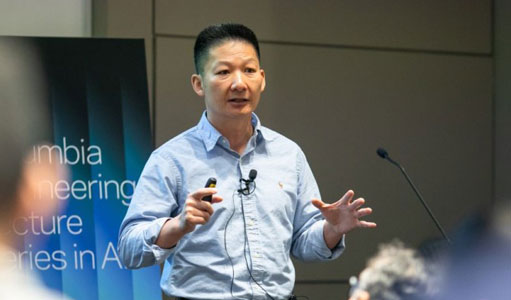
Columbia Experts Urge Calm Amid AI Panic
More transparency is needed, experts say.
Zhuo Zhang and Zishen Wan are among the researchers and innovators who have recently joined Columbia Engineering.
Professor Itsik Pe’er and Associate Professor Eugene Wu have been selected to help lead the National Synthesis Center for Organismal Resilience (NSCORE), a multidisciplinary research center that will bring together biologists and computer scientists to … Continue reading Columbia to Lead $20 Million National Research Center on Organismal Resilience
Computing systems now have to keep pace with increasingly capable artificial intelligence (AI). Robots, agentic AI, autonomous systems, and other … Continue reading Zishen Wan Brings AI-Native Computing Research to Columbia
Associate Professor Brian A. Smith has four Columbia degrees. How did he find his path, and what advice does he have for the rest of us, who are looking for one as well?
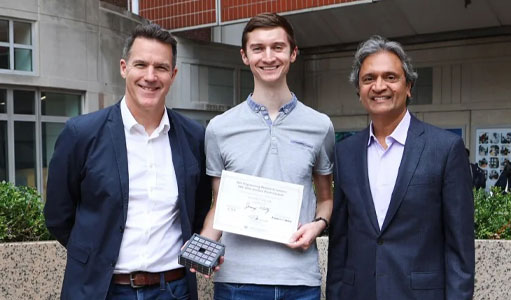
From developing new approaches to artificial intelligence and computer systems to tackling challenges in security, theory, and beyond, PhD students … Continue reading Fellowships Recognize Outstanding PhD Researchers
What makes a quantum proof more powerful than a classical one? A paper by John Bostanci (PhD ‘26) and his … Continue reading Understanding Why Quantum Proofs Can Be More Powerful Than Classical Ones
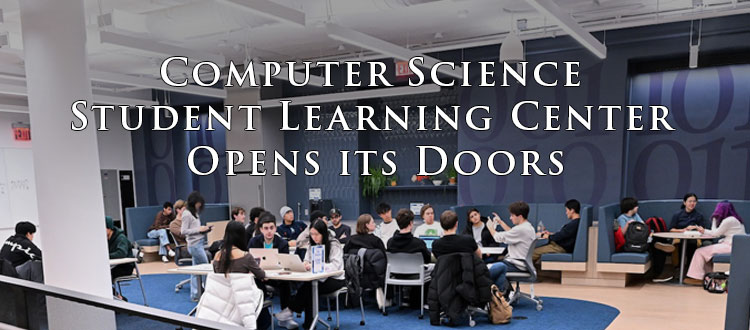
The new space in Schermerhorn Hall will support collaborative learning and community connection among students and faculty.
Many Computer Science PhD graduates go on to careers in academia, bringing together research, teaching, and mentorship in ways that … Continue reading Voices of CS: The Transition From PhD to Faculty
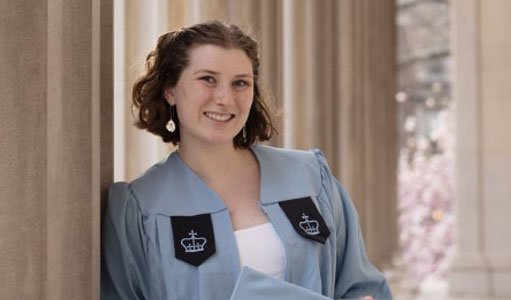
As the academic year comes to a close, we proudly celebrate the achievements, resilience, and growth of the Class of … Continue reading Celebrating the Class of 2026
Find open faculty positions here.
President Bollinger announced that Columbia University along with many other academic institutions (sixteen, including all Ivy League universities) filed an amicus brief in the U.S. District Court for the Eastern District of New York challenging the Executive Order regarding immigrants from seven designated countries and refugees. Among other things, the brief asserts that “safety and security concerns can be addressed in a manner that is consistent with the values America has always stood for, including the free flow of ideas and people across borders and the welcoming of immigrants to our universities.”
This recent action provides a moment for us to collectively reflect on our community within Columbia Engineering and the importance of our commitment to maintaining an open and welcoming community for all students, faculty, researchers and administrative staff. As a School of Engineering and Applied Science, we are fortunate to attract students and faculty from diverse backgrounds, from across the country, and from around the world. It is a great benefit to be able to gather engineers and scientists of so many different perspectives and talents – all with a commitment to learning, a focus on pushing the frontiers of knowledge and discovery, and with a passion for translating our work to impact humanity.
I am proud of our community, and wish to take this opportunity to reinforce our collective commitment to maintaining an open and collegial environment. We are fortunate to have the privilege to learn from one another, and to study, work, and live together in such a dynamic and vibrant place as Columbia.
Sincerely,
Mary C. Boyce
Dean of Engineering
Morris A. and Alma Schapiro Professor